
Advice & Precautions
Many of our nation’s most beloved, popular and common activities take place on / around water throughout the year. However, there are associated risks so it is important to know the do’s and don’ts around water. Helpful advice should always be considered and easy to follow precautions can be taken prior to getting involved with Ireland’s aquatic environments. Likewise, there are actions one can take should they find themselves in trouble or difficult situations.
Surfing & Kitesurfing
If adventure is what you are after, surfing and kitesurfing might just be the sports for you. With great waves and lots of beaches Ireland offers some of the best surfing and kitesurfing in Europe. Remember though, you can experience the thrills of the surf without taking risks.
From beginners to experienced users, we all need to respect the water and others. Before taking out your board be aware of the associated dangers on the water. Many schools provide lessons and will give practical demonstrations.
There is some basic etiquette you can follow which will make your life and those of others easy. The surfer closest to the peak has priority and you should never ‘drop in’ on anybody else. To avoid collision, paddle for white water or paddle wide on the shoulder.


Beach Safety
For most people summer means days at beach, enjoying the sun and sand. By following very easy tips, you can have a safe and happy time at beach
- Learn to swim
- Swim near a lifeguard
- Swim with a buddy
- Check with the lifeguards
- Use sunscreen and drink water
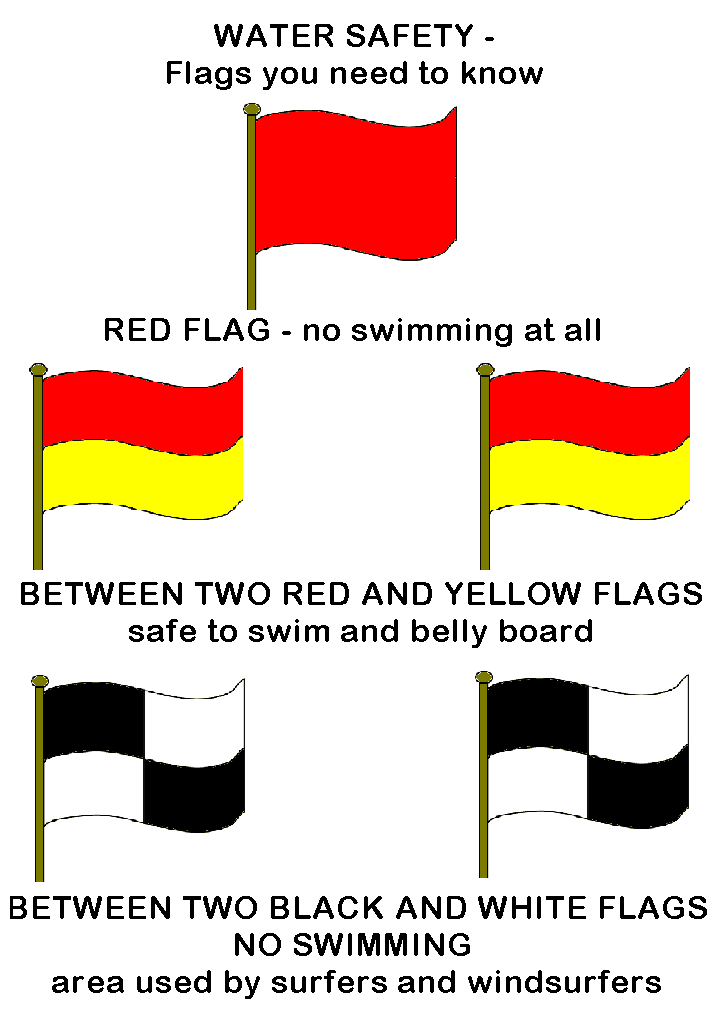
- Obey posted signs and flags
- Keep the beach and water clean
- Learn rip current safety
- Enter water feet first
- Wear a life jacket
Rip Current Safety
As waves travel from deep to shallow water, they will break near the shoreline. When waves break strongly in some locations and weakly in others, this can cause circulation cells which are seen as rip currents: narrow, fast-moving belts of water traveling offshore.
Rip currents are the leading surf hazard for all beachgoers. They are particularly dangerous for weak or non-swimmers. Rip current speeds are typically 1-2 Kmph. However, speeds as high as 8 Kmph have been measured. Thus, rip currents can sweep even the strongest swimmer out to sea.
Rip currents can occur at any surf beach with breaking waves.
Safe Swimming Tips
Swimming is a lot of fun, but drowning is a real danger. Even kids who know how to swim can drown, so let’s find out how to stay safe in the water. First learn swimming then try it and if you are at early stage of learning, use a floating device. Alway go swimming with a buddy and check the depth and the temperature of the water. Never chew gum or eat while you are swimming. Do not swim in the dark and stop swimming as soon as you see or hear storm. Do not swallow the water and have shower after swimming. Do not push or jump into the water. And always check the signs and be sure lifeguards are close.
Venomous Weever Fish
Swimmers, surfers and all beach users need to be vigilant of the little sandy coloured fish that lives in the sea on our beaches. It spends most of the time buried under the sand with just its venomous black dorsal fins showing above the sandy bottom. It grows to a maximum length of 15 cm. They are found all round the Irish coast but mainly in sandy areas where the water is shallow. The public are most at risk close to the mean low water spring tides. This occurs when you have a new moon or a full moon. This causes swimmers, walkers and surfers to venture further out on the beach in to the area where the weever fish live.